



Money works because we trust. We trust that it will still have value tomorrow. That others will accept it. That the rules that underpin it will remain in place. It is probably the greatest exercise in collective faith that humanity has ever devised. The bonds it creates go beyond exchange. They are the threads that build our community, strengthen cooperation, and create a legacy for the future.
By itself, it has no value. Its true value lies in trust. Without it, banknotes are just pieces of paper, or a number on a screen. Money works because we choose to believe in it, because we believe we can exchange it for goods and services, and because we believe in one another. It is a pact of collective trust.
Being aware of this changes the way we understand the value of money. It teaches us that trust is the purest form of wealth, that money creates bonds, and that when it is shared with a clear purpose, its value is not divided but multiplied. It reminds us that the economy does not function solely through calculation, but also through credibility, cooperation, and shared expectations.
The geography of trust: Switzerland, Singapore and the Nordic model
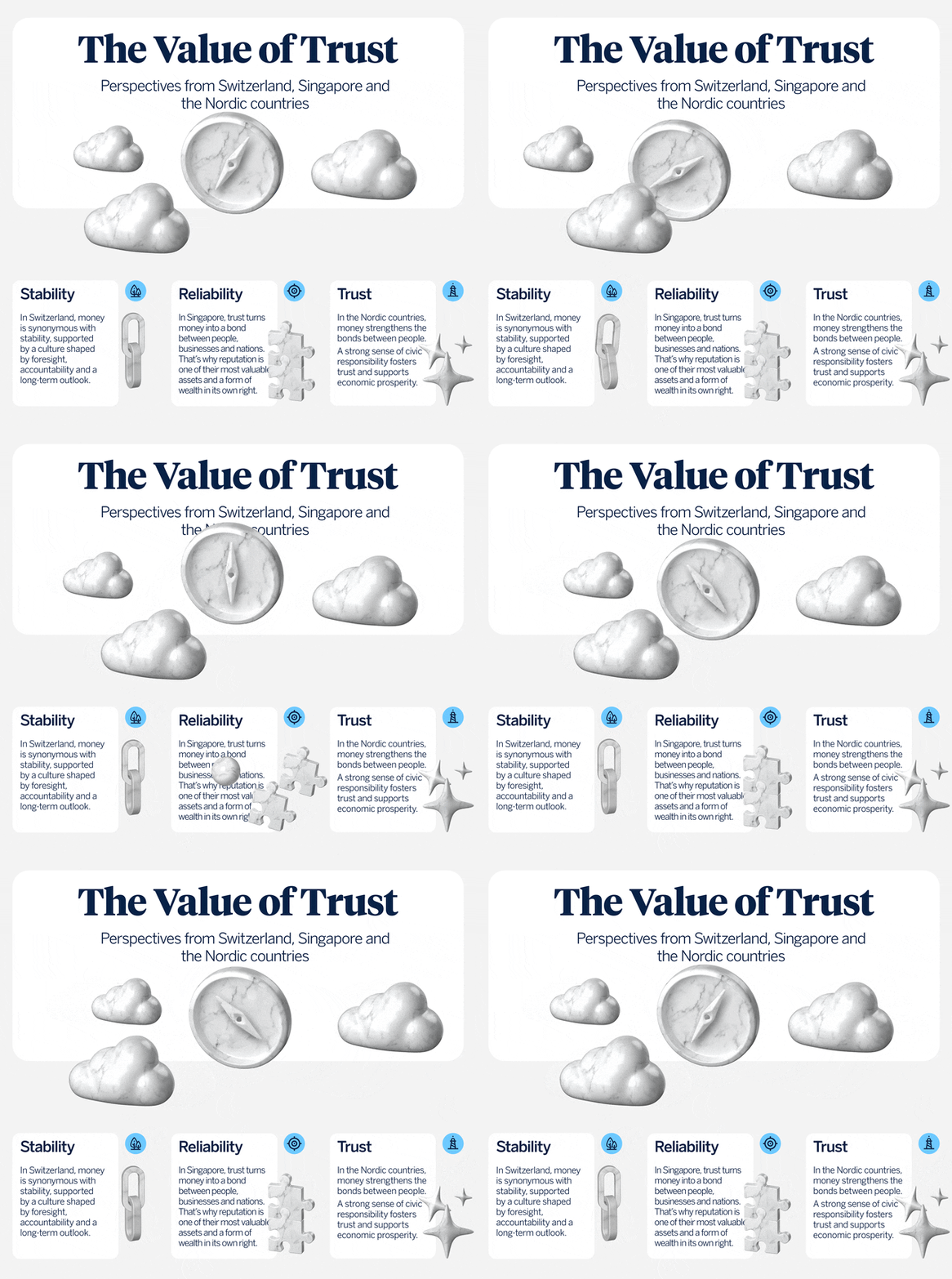
To understand how this trust helps build prosperity, we should look to countries such as Switzerland, where money is synonymous with stability and legal certainty.
In Switzerland, economic stability is supported by a culture in which planning ahead, honoring commitments, and institutional trust play a central role. Moreover, money is not viewed as something to be spent recklessly today, but as a resource that should be protected for tomorrow. These behaviors foster a high level of institutional trust and help money be perceived more as a tool for stability than as a source of uncertainty.
In Singapore, trust acts as the engine that enables a country without natural resources to become a global power. Its growth is based on one non-negotiable premise: absolute integrity. Money works because the system is predictable and reputation is the most stable currency. In this context, prosperity depends less on natural resources than on the ability to be a reliable partner. Its wealth is closely linked to its reputation as a reliable partner.
But trust is not only built externally; it also strengthens the bonds that make communal life possible. In societies such as Denmark and Sweden, the relationship with money is based on a principle of shared responsibility and civic-mindedness. There, capital is not viewed in isolation, but as part of a high-trust ecosystem among citizens.
In this model, respecting the rules of the game and honoring shared commitments are not experienced as coercive impositions, but as a rational choice by free citizens who understand the value of living in an orderly community. There is a natural and spontaneous sense of honesty: each individual contributes their resources because they have complete confidence that the rest of society acts with the same integrity. It demonstrates that when money serves to strengthen social bonds, the sense of scarcity disappears, giving way to a shared sense of security.
From bond to legacy
If trust allows money to circulate, purpose allows it to transcend. This relational dimension of money has attracted the attention of numerous thinkers. One of them is anthropologist Marcel Mauss, who explained that, in its origins, exchange was not a cold transaction, but a ritual for creating relationships and commitments. Today, money recaptures what he calls "the spirit of the gift" when we use it with purpose and turn it into a lasting bond with others.
Giving money its true value also means asking ourselves a question: what mark will I leave on the world? In this sense, money can cease to be a tool for consumption and become a way to project what we value. This happens when we direct our resources toward projects that strengthen our community, help others grow, or contribute to the common good. In this way, we turn money into a legacy: a form of connection with future generations.
Because, ultimately, money only has value as long as there is someone willing to trust in it. And perhaps that is why the most important form of wealth has never been money itself, but the quality of the bonds we are able to build through it.