



Money is talked about a lot, but rarely reflected on honestly. It is expected to deliver performance, stability and growth. Successes and failures are attributed to it. Yet what it truly represents is seldom discussed.
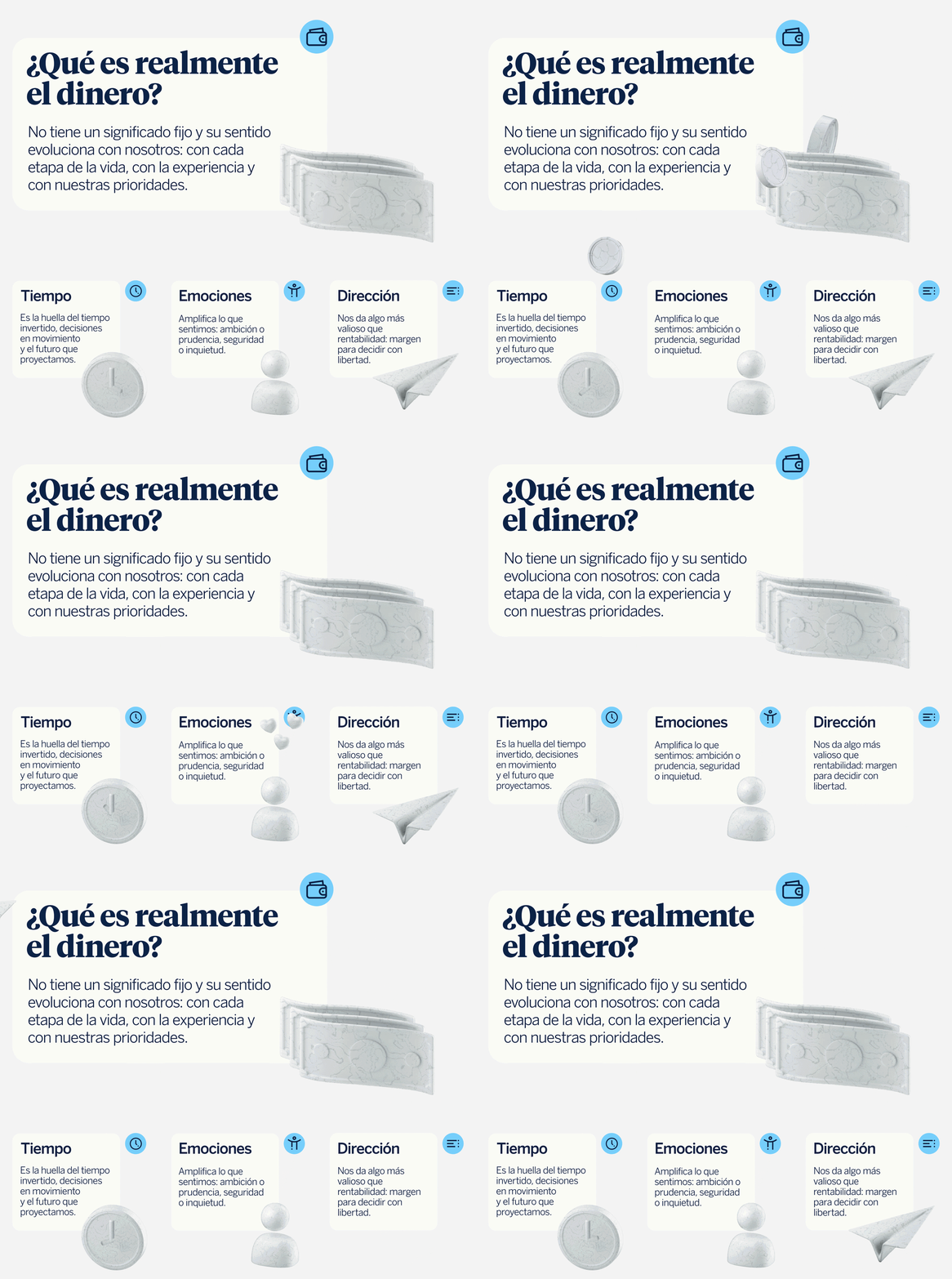
Because money does not have a fixed meaning and its significance evolves with us: with each stage of life, with the experience we accumulate and with the perspective from which we view the world. And in that movement, it reveals something deeper: how we relate to time, to the past that made it possible and to the future we want to build.
Money has a visible side and a quieter one, and from that less obvious dimension the Philosophy of Money emerges. At BBVA in Switzerland, we launched this series of reflections to offer a broader perspective on how money can mean different things. Not to provide certainties, but to open up more thoughtful questions about what it represents in our lives today.
Money and conscious discipline
If money reflects time, it also reveals how we prioritize it. Some decisions focus on the immediate present: to consume, to invest, to seize an opportunity. Others look further ahead: to preserve, to plan, to pass on. Neither is better by definition. What changes is the perspective from which we choose.
That perspective, however, is not always shaped by logic. It is influenced by emotion: the urgency of not being left behind, the fear of missing out, the euphoria when something works, or the impulse to protect what has been built. In a world that leaves little room for waiting and favors instant decisions, money can become an accelerator. It responds to the rhythm of the moment, to immediate reward, to the sense of constant progress.
But over time, that relationship can shift. There were times when accumulating capital meant decades of work, inheritances passed down slowly or projects that matured over generations. Decisions required a pause because the context itself imposed it. Today, by contrast, speed is part of the environment. Transfers are instantaneous, investment is immediate, consumption requires no waiting. Money moves at a pace that transforms not only how we use it, but also how we perceive it.
It is not necessarily the amount that changes; it is the intention. Understanding this difference is a form of discipline, not as restriction but as coherence: coherence between what we value today and what we want to remain tomorrow.
Money as a multiplier of options
Our relationship with money is not built in a vacuum. It is shaped by our personal history, by the environment in which we grew up and by the way we learned to speak — or not speak — about risk, success or stability.
Over time, that perspective evolves. What represents independence at one stage may later become responsibility. What began as an individual achievement may develop into a shared project. As we change, so too does the meaning we attribute to money and the emotions that accompany it.
To see it only as a resource is to miss something essential. In reality, it embodies time, effort and accumulated decisions. And when it moves, that energy is far from neutral: it can awaken calm or unease, ambition or prudence, a sense of control or the fear of loss. Money does not only finance actions; it also activates emotions.
That is when money stops being merely an amount and becomes a possibility. It broadens the scope from which we decide. And that scope is, ultimately, a form of freedom: the freedom to direct our resources towards the future we believe in.