




Asia is undergoing a profound economic transformation. The continent that for decades was the world's great factory now faces a new stage marked by technology, investment, new supply chains and the expansion of its middle class. The figures reflect its importance in the global economy: Asia generates around two-thirds of global growth and accounts for almost 40% of world trade, according to data from the International Monetary Fund (IMF).
China wants to stop being just the world's factory
Over the past five decades, China has gone from registering high levels of poverty to becoming one of the world's leading industrial and technological powers. Electric vehicles, digital payment systems, automation and the development of cities that incorporate disruptive solutions are some examples of its growing technological capacity. China seeks to strengthen its position in higher value-added activities and reduce its dependence on foreign demand.
"From an export model led first by Japan, then by the four Asian tigers (South Korea, Taiwan, Singapore and Hong Kong) and, above all, by China following its entry into the World Trade Organization (WTO), Asia industrialized by integrating into global chains, saving a lot and investing more. The result: rapid convergence, but also dependence on external US demand U.S. as a market and from China as a factory," argues Alicia García Herrero, economist at the Bruegel research center.
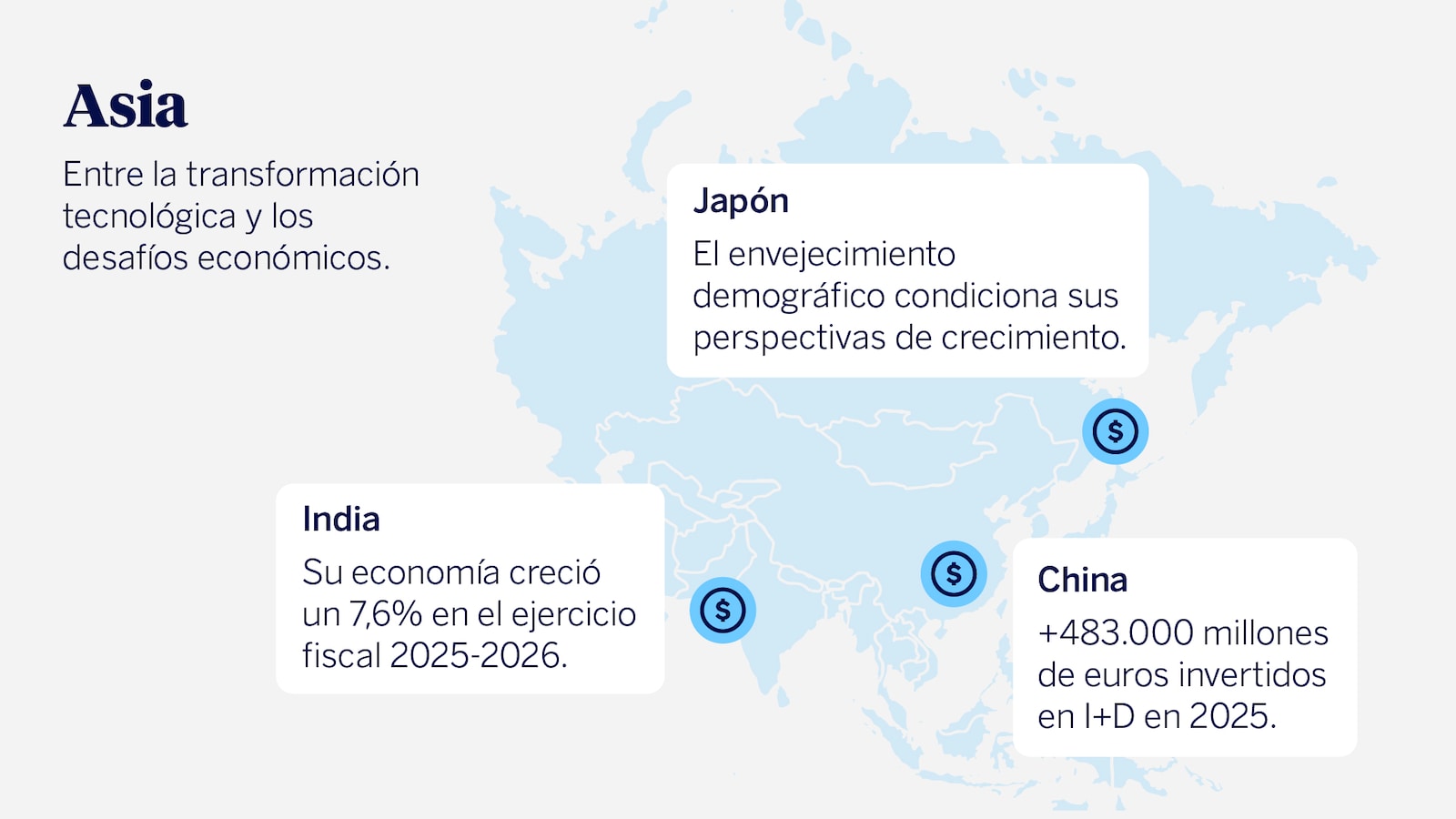
The most recent data point to a change in the composition of Chinese investment. In 2024, China allocated more than 483 billion euros to Research and development (2.80% of GDP) and accounted for 49% of invention patents registered globally.
A region with very different economies
China's transformation cannot be extrapolated to an entire continent that combines diverse economic and demographic models. García Herrero speaks of "dispersion and fragmentation" to describe this scenario. "There is no single Asia," explains the expert, "China grows less and sustains itself with exports and industry, not consumption. India is growing faster, but maintains a greater emphasis on services and the domestic market. Japan and South Korea are mature economies, rich in technology and capital, with adverse demographics. And Southeast Asia is the big tactical beneficiary of diversification, with very different realities between Vietnam, Indonesia and the Philippines."
India stands out for its rate of economic growth. Its economy grew by 7.6% in the 2025-2026 fiscal year, after advancing by 7.1% the previous year. It, however, continues to face structural challenges. These include the considerable weight of the primary sector (agriculture, livestock or fishing) in employment. Around 40% of the workforce is employed in these areas, according to the World Bank report. India is becoming a high-income economy in a generation.
Japan, meanwhile, is facing a new economic phase after decades of low inflation, moderate growth and near-zero interest rates. Real GDP grew by 1.2% in 2025, but the Organisation for Economic Co-operation and Development (OECD) forecasts moderation to 0.7% in 2026 and 0.9% in 2027. According to the OECD, the main driver will be domestic demand, especially consumption and corporate investment.
Aging and a labor shortage are driving wage increases, while public debt exceeds 205% of GDP. The Bank of Japan's interest rate hike marks a change after years of expansionary monetary policy. Meanwhile, the demographic challenge will increase the pressure on pensions, healthcare and care. Monetary normalization also raises questions about the weight of the carry trade financed in yen.
The differences are observed in the rest of the region's industrial strategies. According to Alicia García Herrero, Vietnam is gaining relevance in assembly operations, although it maintains a strong dependence on components from China. Indonesia is betting on nickel and batteries, with risks associated with overcapacity and dependence on Chinese capital. South Korea and Taiwan hold strategic positions in the semiconductor industry, in a context marked by technological competition between the US U.S. and China. "Asia is not divided into two clean blocs. The continent will continue to drive the world economy, but with less impetus from China and with more dispersion," admits the researcher from the Bruegel center.
A growing middle class
Asia's economic growth is also linked to the expansion of the middle classes. This trend will be especially relevant in the countries of the Association of Southeast Asian Nations (ASEAN). Today, it represents around 6% of global GDP and could reach 9% in the coming decades.
According to OECD projections, ASEAN's GDP per capita could reach $28,600 by 2050, compared to an estimated global average of $27,500. Among the trends that will shape the coming years, García Herrero identifies digitalization, electrification, the application of artificial intelligence to industry, nearshoring and friend-shoring towards ASEAN, in addition to the growth in consumption in countries such as India and Indonesia.
Robotics is gaining prominence in Asia's industrial transformation
Robotics is another sector that can strengthen Asian technological leadership. China installed 354,000 industrial robots in 2025, 59% of all new installations worldwide, according to data from the International Federation of Robotics (IFR). India also increased its installations to almost 10,500 units, 15% more than the previous year.
The trend suggests that robotic expansion will continue. The International Federation of Robotics predicts that installations worldwide will increase from more than 600,000 robots in 2025 to 806,000 in 2029. Population aging and labor shortages increase the incentive to incorporate robots into industrial processes.