




During the last few years, several countries in the region have improved a series of macroeconomic indicators, favored by more contained inflation in economies such as Brazil or Chile and by a relatively favorable international environment. But future developments will continue to be conditioned by political and fiscal factors and as a consequence of the international environment's evolution.
South America is a territory that continues to have a relatively small weight within large international capital allocations. The recent evolution of a series of macroeconomic indicators justifies a more detailed analysis of a region that combines advances in economic stability, but presents political and fiscal challenges as still relevant issues.
According to data from the Economic Commission for Latin America and the Caribbean (ECLAC) and the World Bank, several South American countries are gaining greater economic importance thanks to the availability of critical resources and a relatively favorable demographic. However, their markets maintain lower valuations than those of other emerging economies.
Emanoelle Santos, XTB Latam analyst, believes that the current configuration of the region “is neither a product of chance nor an indirect consequence of external factors,” but the result of a “long-gestating institutional maturity.” This analyst emphasizes that more than three-quarters of the sovereign rating outlooks in the region "are stable", with four positive outlooks and no negative ones, although there are exceptions for countries like Bolivia.
Improvements in debt and inflation, although with differences between countries
One of the factors that has contributed to macroeconomic stability has been the actions of several central banks, especially those of Brazil and Chile, which tightened monetary policy early in response to post-pandemic inflation. This allowed them to contain inflation sooner than other economies. According to the analyst, this has led to their currencies being less affected than those of other emerging markets following the shock of the Iran war, "due to both geographical distance and a lower dependence on energy supplies that pass through the Strait of Hormuz."
In macroeconomic terms, such as debt or inflation, the indicators show slight progress, although they maintain relevant weaknesses: according to the current records of the International Monetary Fund, the ratio between gross debt and Gross Domestic Product (GDP) for the region stands at 72.6%, a figure that contrasts with the 123.7% averaged by the G7 (Group of 7).
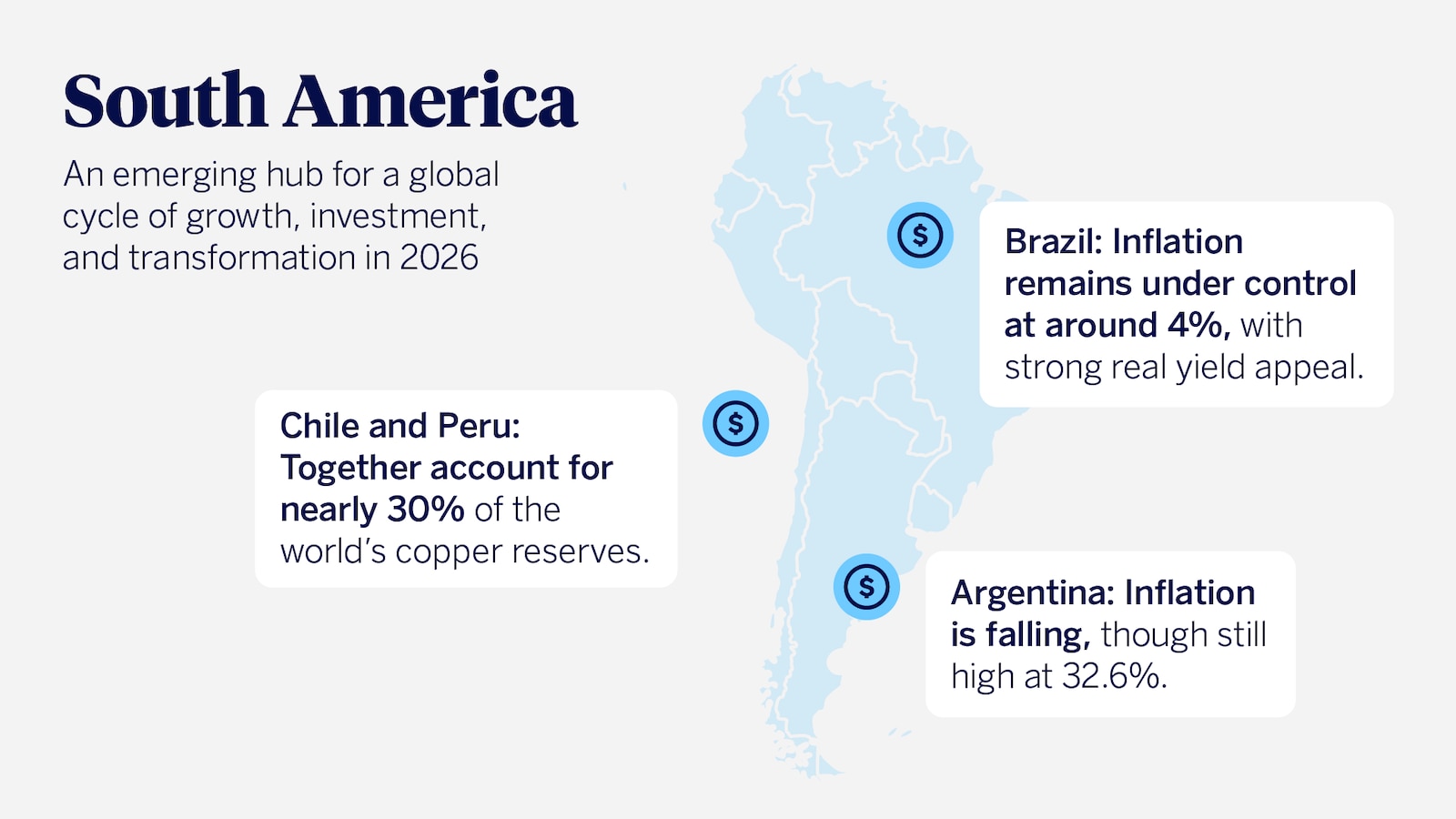
Inflation remains one of the main challenges for these economies. The regional average closed 2025 at 5.47%, a rate that is still high, although lower than the 10.08% recorded in 2024. Argentina continues to be an exception, with an inflation rate of 32.6%. In that sense, Santos warns that “cyclical vulnerability remains a tangible reality. Public finances continue to be a weak point for several Latin American sovereigns that suffer from high deficits, which ultimately limit the fiscal leeway to implement countercyclical policies in the region's largest economies."
The effect of the dollar: a temporary boost
The currency factor has also played a decisive role in the economic improvement of the past year. The year 2025 was marked by a structural weakness of the dollar, which had a positive impact on South American accounts. According to IMF data, the cost of servicing external debt denominated in dollars fell by 12% in countries like Colombia and Brazil.
Santos explains that the fall of the dollar “boosted the value of non-dollar-denominated assets and reduced the corporate debt burden.” However, this expert warns of a temporary favorable factor that could be reversed "if the US dollar regains its global strength."
This situation regarding currencies and interest rates temporarily favored carry trade operations (strategies that take advantage of interest rate differences between countries) and contributed to an inflow of foreign capital into some countries, such as Brazil, where high real interest rates favored the inflow of foreign capital into fixed income markets. Its real interest rate remained among the highest in the world, at approximately 10.9%. The XTB Latam analyst reveals that in January of this year, "a historic flow of 33 billion reais was recorded on the B3 stock exchange in a single month."
Nevertheless, the persistence of these capital flows faces “risks that should not be ignored.” Santos explains that the Central Bank of Brazil reduced the benchmark interest rate to 14.50% in April, and the consensus projects that the Selic rate will be close to 12.25% by the end of the year, which would involve a gradual erosion of the relative appeal of the carry trade.
Structural increase in demand for raw materials
The world is immersed in a new electrical revolution driven by artificial intelligence (AI), which is generating a structural increase in demand for certain raw materials. The high dependence on exports continues to be one of the main vulnerability factors for several South American economies, especially in the face of possible changes in the global economic cycle or the growing demand from China.
For Emanoelle Santos, this revolution “is reshaping the risk profile of Chile, Peru and Brazil in an unprecedented way in the last twenty years.” In her view, “unlike the supercycle led by Chinese urbanization at the beginning of the century, the current momentum is fueled by the digital and green transitions.” “Copper, therefore, is no longer just a building material, but the backbone of the 21st-century economy,” she says.
Political uncertainty as a growing risk
The political landscape of 2026 will be one of the main factors shaping the region's economic evolution, with crucial elections in Colombia and Brazil. In the South American giant, polarization is extreme, with Lula da Silva seeking a fourth term versus Flávio Bolsonaro, in a scenario of a technical tie according to the most recent polls ahead of the October elections. Santos warns that “the rhetoric about fiscal discipline during the campaign could alter inflation expectations and widen sovereign spreads.” In Colombia, however, “the market anticipates a shift towards more investment-friendly policies after the March primaries, although the risk of a weak legislative coalition remains,” she emphasizes.
The region's financial markets have also reflected this macroeconomic improvement, although their evolution continues to be highly conditioned by external factors and political uncertainty. “Regional stocks are trading at valuation multiples significantly lower than their historical averages,” notes this expert, who recommends caution in their investments.
In 2025, the MSCI Latin America index registered a significant rise, driven by both the improved macroeconomic environment and technical valuation factors. However, the continuation of this trend will depend on the international political and financial context. This indicator closed with a 55.3% increase and places the five-year annualized return at 13.19%. In the first quarter of 2026, the Brazilian stock market consolidated itself as one of the most bullish indices in the world, with gains above 25%.
Although some indicators show a more favorable evolution than in previous years, the South American region continues to face structural challenges that limit its ability to maintain sustained growth. The political environment's evolution, the fiscal discipline and the international context will remain the main factors that will determine its trajectory over the next few years.